Free Online French lessons

Après / Avant


This slideshow requires JavaScript.

In this Free Online French Lesson, you will learn how to use the two words “Après” & “Avant” in French. Here is the theory followed by few examples that you can see on the previous pictures :

Après + Infinitif passé + complément (the “infinitif passé” uses “avoir” unless it is one of the verbs which uses “être” in “passé composé”. These verbs are MRS VANDETRAMP verbs and reflexive verbs)

Après avoir fait le ménage, j’ai fait les courses.

Après avoir fait mes devoirs, j’ai fait du sport.

Après avoir fait la vaisselle, j’ai fait une lessive.

Après avoir fait la grasse matinée, j’ai fait la cuisine.

Après avoir fait la queue pendant une heure, j’ai acheté des habits.

Après avoir mes valises, je suis partie en vacances.

Avant + de + Infinitif

Avant de faire les courses, j’ai fait le ménage.

Avant de faire du sport, j’ai fait mes devoirs.

Avant de faire une lessive, j’ai fait la vaisselle.

Avant de faire la cuisine, j’ai fait la grasse matinée.

Avant d’acheter des habits, j’ai fait la queue pendant une heure.

Avant de partir en vacances, j’ai fait mes valises.


Here are two examples using “être” :

Après m’être réveillé(e), je me suis habillé(e).

Après être allé(e) chez le dentiste, je suis rentré(e) chez moi.

Après être allé(e) aux toilettes, je me suis lavé(e) les mains.


Bon travail & à bientôt !


Free Online French lessons

Le gérondif / Le participe présent

How to build the “Participe présent” in French ? You need to take the stem of the verb conjugated in present with “nous” and then add -ANT at the end.

Here are few examples : Mangeant, Chantant, Parlant, Allant, Faisant.

How to build the “Gérondif” in French ? You need to write EN first and then add the “Participe Présent

Here are the same examples in Gérondif : En mangent, En chantant, En partant, En allant, En faisant.

In these pictures you will find the “gérondif” in realistic situations :

This slideshow requires JavaScript.

The french gérondif is often use to add details about how you did something and usually translate in English with “while” and verbs finishing by”-ing”:

Comment tu t’es coupé ? Je me suis coupé en cuisinant (How did you cut yourself ? I cut myself while cooking)

Comment as-tu amélioré ton français ? J’ai amélioré mon français en regardant des films français. (How did you improve your French ? I improved my French watching French movies)

Bon travail à tous !

Free Online French lessons · Free Online French lessons for beginners · French exercise · vocabulaire

Résolutions 2019

résolutions 2019
résolutions 2019

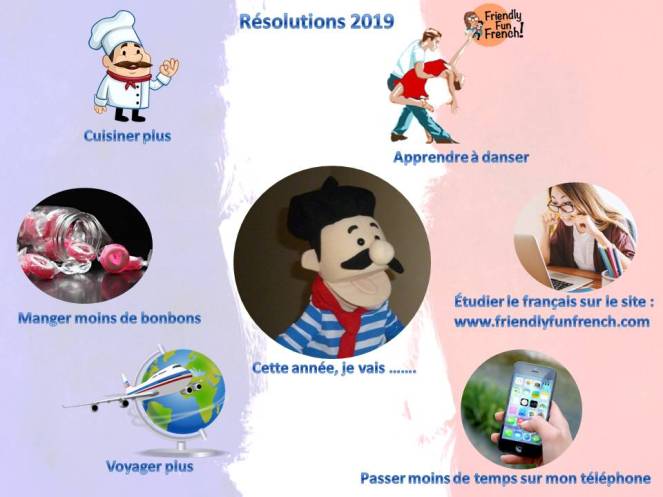
Voici les résolutions de Monsieur Moustachou pour l’année 2019 :

Cette année, je vais cuisiner plus. = This year, I am going to cook more.

Cette année, je vais manger moins de bonbons. = This year, I am going to eat less sweets.

Cette année, je vais voyager plus. = This year, I am going to travel more.

Cette année, je vais apprendre à danser. = This year, I am going to learn to dance.

Cette année, je vais étudier le français sur le site http://www.friendlyfunfrench.com. = This year, I am going to study French on the website http://www.friendlyfunfrench.com.

Cette année, je vais passer moins de temps sur mon téléphone. = This year, I am going to spend less time on my phone.

Vous aussi vous avez de nouvelles résolutions pour cette nouvelle année ? N’hésitez pas à nous les partager !